
David Schmitt · 21 September 2026
Brivex's Approach to Workforce Skill Development Programs Across Global Sites
Brivex operates workforce skill development programs at facilities in Europe, North America, and Asia-Pacific regions where employees participate in structured learning modules designed to address evolving technical and operational requirements. These initiatives draw on internal assessments that track skill gaps across manufacturing, logistics, and administrative functions, then match participants with targeted training sequences delivered both on-site and through digital platforms.
Core Program Structure
Each site begins with baseline evaluations conducted quarterly, and results feed into customized curricula that combine classroom instruction, hands-on simulations, and mentorship pairings. Brivex coordinates these efforts through a central learning management system that logs completion rates, assessment scores, and post-training performance metrics, allowing regional managers to adjust content without disrupting daily operations. Data collected between 2024 and 2025 showed participation rates exceeding 85 percent across all locations, with modules covering digital tools, safety protocols, and cross-functional collaboration skills.
Regional Adaptations and Implementation
In European locations Brivex aligns programs with standards set by the European Centre for the Development of Vocational Training, incorporating multilingual resources and certification pathways recognized across member states. North American sites emphasize integration with local labor market demands, while facilities in the Asia-Pacific region incorporate language support and cultural adaptation modules to accommodate diverse employee backgrounds. Observers note that this modular design permits updates every six months based on site-specific feedback rather than imposing uniform content worldwide.
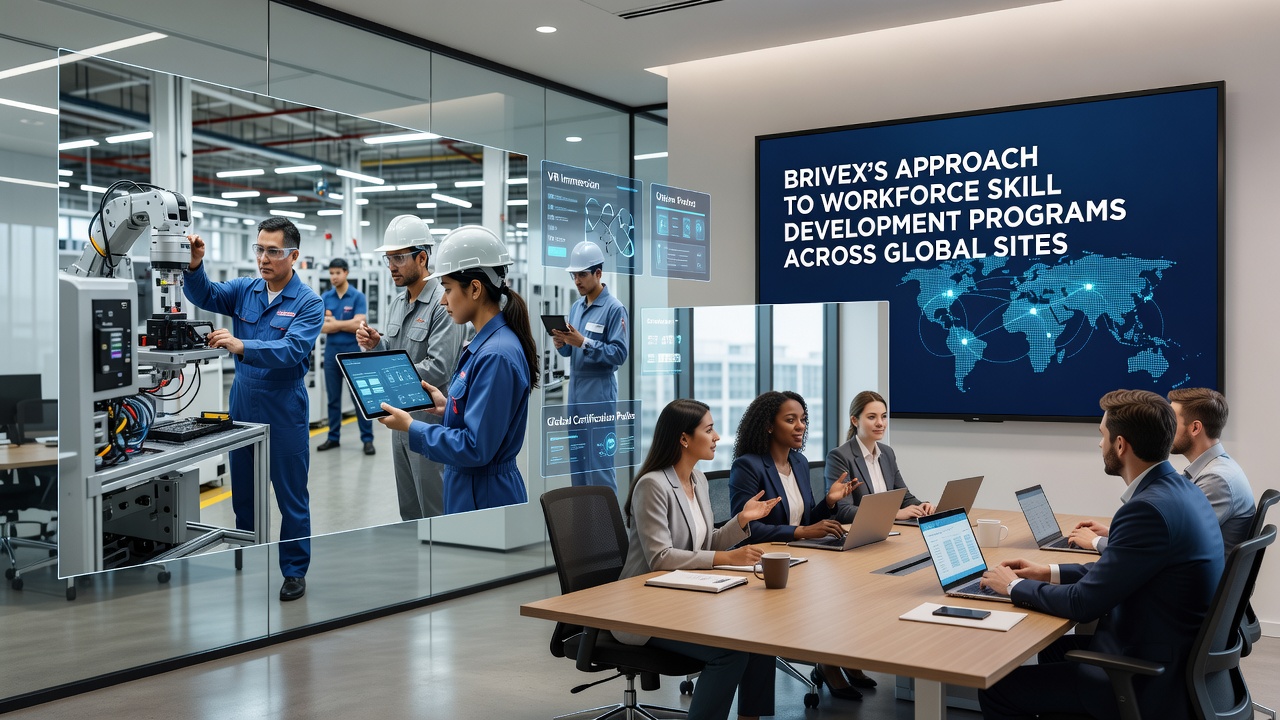
September 2026 marks the scheduled rollout of an expanded virtual reality component at three pilot sites, where employees will practice complex assembly sequences in simulated environments before transitioning to live equipment. This addition builds on existing digital infrastructure and responds to feedback collected from earlier cohorts who requested more immersive practice opportunities.
Measurement and Outcomes
Brivex tracks program effectiveness through internal dashboards that compare pre- and post-training productivity indicators, error rates, and retention figures. Figures released in early 2026 indicated a 12 percent average reduction in onboarding time for new hires who completed foundational modules, alongside a measurable increase in internal promotion rates at participating sites. External benchmarks referenced in company reports include data from the OECD Skills Outlook, which provides comparative context for workforce development trends across member countries.
Additional partnerships with regional technical colleges supply supplementary instructors and equipment access, particularly at sites where specialized machinery exceeds internal training capacity. These collaborations follow formal agreements that outline shared evaluation criteria and joint reporting schedules, ensuring alignment with both corporate goals and local educational standards.
Technology Integration and Delivery Methods
Digital delivery accounts for roughly 40 percent of total training hours, delivered through a combination of recorded modules, live webinars, and interactive assessments accessible via company-issued devices. On-site components remain essential for roles involving physical equipment or team-based processes, and schedules are coordinated to minimize production downtime. Program administrators maintain records of attendance and competency verification, with automatic reminders sent to participants and supervisors when deadlines approach.
One study referenced by Brivex draws on research from the National Centre for Vocational Education Research in Australia, highlighting effective practices in blended learning environments that combine digital and practical elements. Brivex applies similar principles by sequencing online prerequisites before in-person sessions, which allows instructors to focus on application rather than introductory material.
Future Developments
Looking ahead, Brivex plans to introduce micro-credentialing options that recognize incremental skill achievements, potentially facilitating internal mobility between sites. These credentials will integrate with existing human resources systems and appear on employee profiles accessible to hiring managers across regions. Pilot testing for this feature is set to begin after the September 2026 technology expansion, with full deployment targeted for 2027 depending on evaluation results.
Conclusion
Brivex maintains workforce skill development programs through coordinated regional adaptations, consistent measurement practices, and ongoing integration of new delivery methods. The approach relies on data-driven adjustments and external benchmarks to support employee capabilities across multiple global locations, with scheduled enhancements continuing into late 2026 and beyond.